 Analysis by Gamescozy
I went into Car Crash Simulator: Mountain expecting the appeal to be simple: point a car down a dangerous slope and see what happens when control gives way. That is the core attraction, but the game’s steep mountain routes give each attempt a little more purpose than a crash toy alone. You are trying to manage a descent, judge the road and find out how much punishment the car can take. I find that mix satisfying in short bursts, though it suits players who enjoy experimenting more than those looking for a carefully guided racing campaign.
Reading the road and finding an early goal
This is a free racing game from Moon Star Games Yazilim, built around driving on mountain roads and the spectacle of cars deforming in collisions. Its opening appeal is immediate: the road itself is the first challenge. A steep descent can make even a modest steering correction feel consequential, so I focus on keeping the car pointed where I want it rather than treating the course like a conventional flat circuit.
The early goal is less about mastering a complicated set of rules and more about learning how the vehicle responds. On a first run, I would resist the urge to drive at full speed just to reach a crash. Try a controlled pass, notice where the slope begins to pull the car off line, and use the next attempt to change one thing. That small routine makes the driving feel more deliberate and helps separate a mistake caused by speed from one caused by poor positioning.
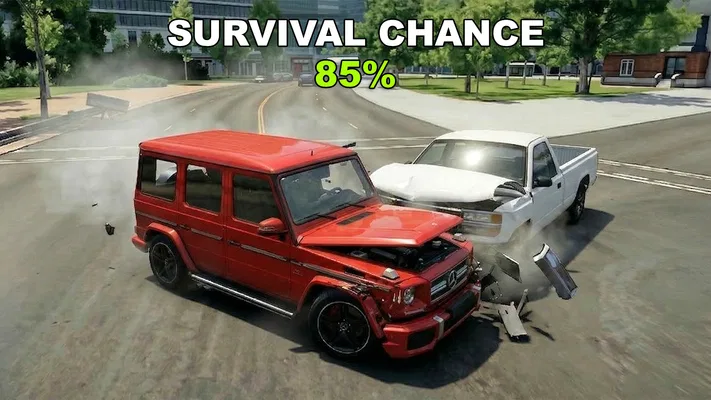
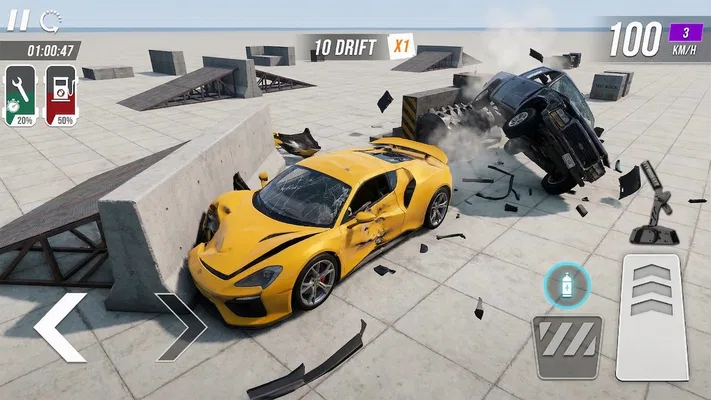
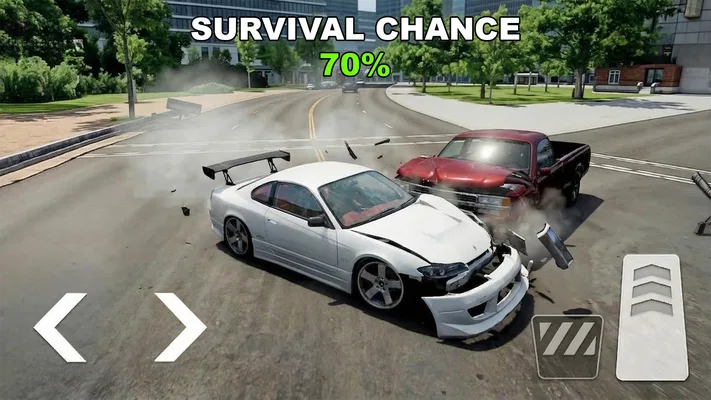
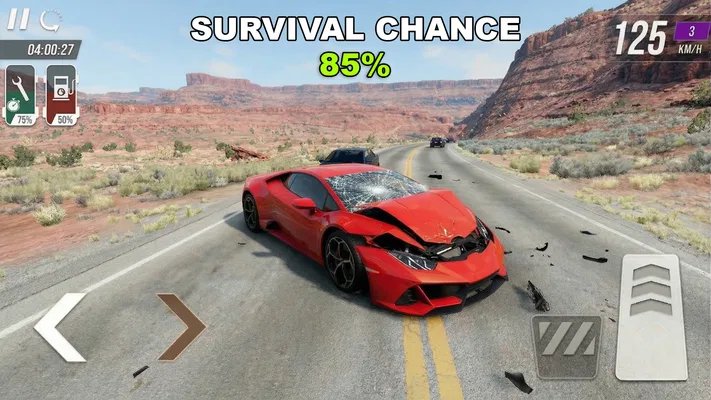
The soft-body damage is central to the game’s identity. A collision is not merely a reset point; the car’s visible deformation gives the impact a physical quality that is different from the clean, arcade-style spinouts common in lighter racers. I like that the damage can make a run entertaining even when the driving goes badly. The trade-off is that people who want tidy lap times and consistently clean finishes may find the crash focus distracting rather than fun.
There is a useful distinction between playing for control and playing for spectacle. If I am in a patient mood, I treat the descent as a test of careful steering. If I only have a few minutes, I can make a more reckless attempt and enjoy the consequences. That flexibility is a strength: the same mountain setting can support a focused run or a quick, chaotic session without requiring a long warm-up.
Small experiments make each attempt more useful
Instead of repeating the same fast approach, I recommend changing one driving choice at a time. Begin with a slower descent and keep your corrections gentle; then try a more aggressive line and compare how the car handles the slope. If a run ends in a collision, the helpful question is not simply whether the crash looked dramatic, but what led to it: too much speed, a late turn, or a line that left little room to recover. This is a practical way to create your own short-term goals even when you are not following a formal checklist.
It also helps to decide what counts as a successful attempt before starting. You might aim to stay composed through a difficult section, reach a particular stretch without losing control, or deliberately test how an impact changes the car. Those are player-made targets rather than claims about built-in objectives, but they give the driving more shape. Without that self-directed approach, the loop can become “drive, crash, repeat” surprisingly quickly.
Progress, challenge and the reasons to keep playing
Progress in a game like this is easiest to feel through your own improved judgement. A run that once seemed impossible can become manageable once you understand how quickly the steep road demands a correction. I would not approach it expecting the conventional structure of a racing game, where a calendar of events, a career ladder or a detailed set of rewards steadily tells you what to do next. Its strongest progress signal is the difference between an uncontrolled descent and one you can steer with intent.
That distinction matters when deciding whether the game will hold your attention. Players who enjoy refining technique can find a reason to return: try a different approach, see whether a calmer pace prevents an early collision, and learn where a risky manoeuvre stops being worth it. Players who need a stream of explicit goals may feel less directed. The game’s central idea is clear, but the pleasure depends heavily on whether the driving and damage are enough to motivate another attempt.
The challenge comes from combining a steep route with the risk of losing control, not from the usual competition against a pack of racers. That gives the game a distinct rhythm. You are judging the road and your own handling rather than constantly reacting to opponents. I find that appealing when I want a driving game that feels less like a race and more like a physics playground, but it is not a substitute for close wheel-to-wheel competition.
The difficulty can feel uneven from one run to the next because the same mistake has a different emotional weight depending on how much control you had before the impact. That volatility is part of the fun, but it can also make improvement harder to read. To keep frustration down, I would avoid treating every collision as proof that the game is unfair. Slow down, repeat the section with a simpler line, and only increase the risk once you have a better sense of the descent.
What the crash focus does well—and where it narrows the appeal
Compared with a standard arcade racer, this game places less emphasis on beating rivals and more on the relationship between car, slope and impact. Compared with a pure driving simulator, its damage spectacle makes failure entertaining instead of merely inconvenient. That middle ground is its best quality. The trade-off is that the crash can become the main event, so anyone seeking realistic traffic, deep vehicle tuning or a broad motorsport career should look for a different kind of racing game.
For a useful everyday session, I would play it during a short break when I want immediate feedback rather than a long commitment. I can make a careful run, decide what went wrong, then try once more with a single adjustment. It also works for someone who enjoys sharing a game with a friend in the same room: each person can take a turn and compare driving approaches or reactions to a collision. I would not promise that it offers a dedicated multiplayer mode; the point is that its easy-to-understand premise makes informal turn-taking natural.
There is also a good reason to stop after a handful of attempts. Since the central activity remains mountain driving and crash testing, novelty may fade if you are not setting your own challenges. I would treat it as a focused pick-up-and-play game, not assume that it will become a long-term racing project. That expectation makes the concise loop feel like a deliberate choice instead of a missing feature.
Version, cost and who should try it
The game is free to install, with in-app purchases listed at $2.49 per item. I would start without spending and see whether the core driving loop is enough for you. A purchase makes sense only if you have already decided that you want to invest further; it should not be treated as a requirement for enjoying the basic premise. The current version is 3.0.45t, and the minimum operating-system requirement is version 10, so it is worth checking your device settings before downloading.
Its audience rating is Everyone, which makes the game broadly accessible by age classification, but the crash-centred theme may still be a matter of personal taste. The game has an average rating of 3.5 from around four thousand ratings, alongside 176 written reviews. That mixed reception is a useful reminder that a focused concept can click strongly with some players while feeling repetitive to others. It has passed one million installs, so there is a sizeable audience for its particular take on racing, though popularity alone cannot tell you whether its loop fits your preferences.
I would recommend it most to players who enjoy car damage, risky descents and learning through trial and error. It is less suited to anyone who wants a structured championship, a large variety of racing disciplines, or a calm simulator where collisions are something to avoid at all costs. If you are unsure, the free entry point makes it reasonable to test the core idea before deciding whether the purchase options matter to you.
My verdict on its progression and staying power
Car Crash Simulator: Mountain earns its place as a compact, distinctive racing game by giving steep roads and soft-body crashes a clear shared purpose. The mountain descent provides the immediate challenge; the damage gives failure personality; and the player’s improving control can supply a modest sense of progress. Those elements work best when I set a small target for each run instead of waiting for the game to provide a long list of milestones.
Its retention pressure is gentle rather than forceful. The premise encourages another attempt because I want to see whether a different line or speed will produce a better descent, but the same focus can limit its staying power once I have exhausted my interest in driving and crashing. That is the key trade-off: it offers a memorable, specific activity rather than a wide racing package. For a quick, physics-led diversion, I think it is worth trying. For a player who needs clear unlock goals and a substantial progression ladder to stay engaged, a more structured racer will be the better choice.